Choosing the right cricket bat weight can make a significant difference to your batting performance. Whether you play competitive league cricket, weekend matches, indoor cricket, or casual games in the USA, the right bat should help you generate power, maintain control, and play shots with confidence.
Many players assume that a heavier cricket bat automatically delivers more power. However, a bat that is too heavy can slow down your swing and make it harder to time the ball. On the other hand, a lighter bat can help you react quickly, control your shots, and adjust to different deliveries.
The key is to find a bat that matches your playing style, physical strength, batting technique, and preferred format of cricket.
In this guide, we explain how to choose the right cricket bat weight for your game, with practical advice for beginners, club cricketers, and experienced players across the United States.
1. Understanding Cricket Bat Weight
Cricket bat weight is generally measured in pounds and ounces in the USA, although many manufacturers and retailers also list weight in grams.
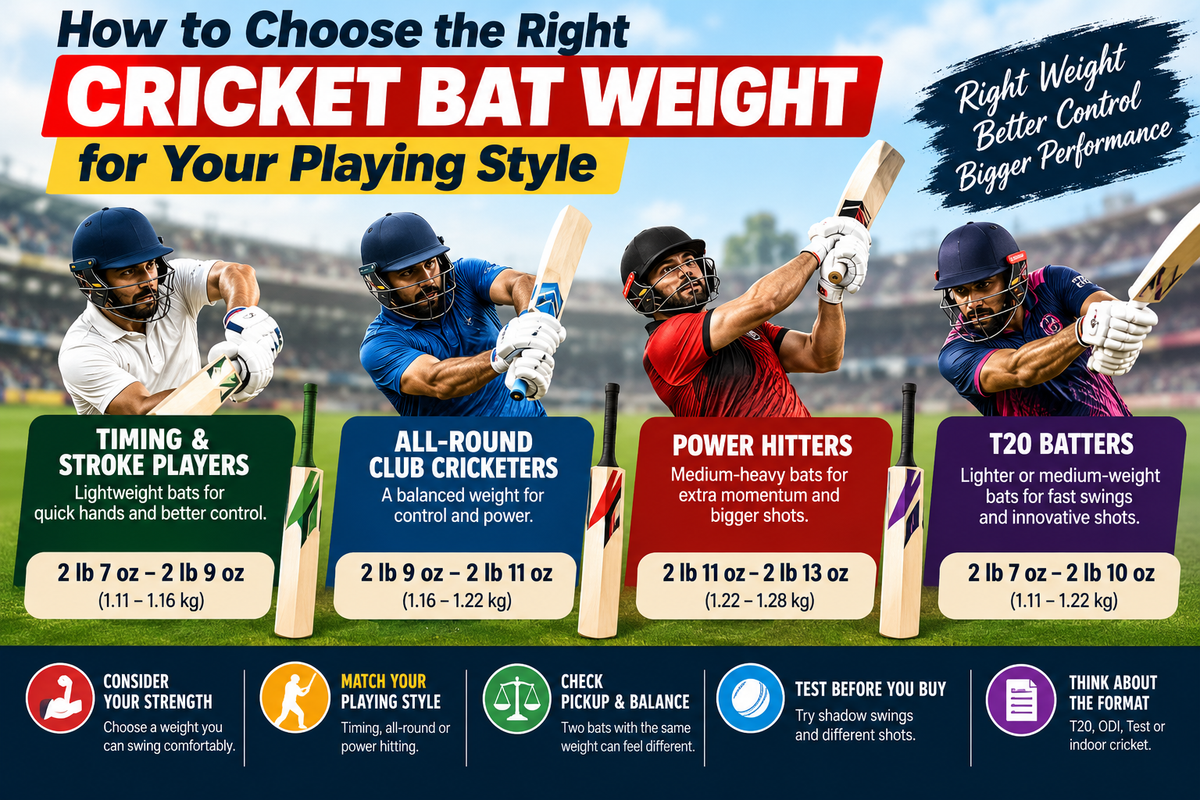
For most adult players, a bat weighing approximately 2 lb 7 oz to 2 lb 12 oz is a useful starting range. Your ideal weight will depend on how comfortably you can swing the bat and maintain control throughout an innings.

Lightweight Bats
2 lb 7 oz–2 lb 9 oz
Approximately 1.11–1.16 kg
Ideal for quick hands, stroke play, fast bat movement, and players who prioritize timing.

Medium-Weight Bats
2 lb 9 oz–2 lb 11 oz
Approximately 1.16–1.22 kg
A versatile option for club players who want a balance of bat speed, control, and hitting power.

Medium-Heavy Bats
2 lb 11 oz–2 lb 13 oz
Approximately 1.22–1.28 kg
May suit stronger players who prefer a substantial feel and can maintain fast, controlled swings.
These ranges are general guidelines, not strict rules. Two bats with identical scale weights can feel different because of their balance and weight distribution.
2. Choose Your Bat Weight Based on Your Playing Style
Your batting style is one of the most useful factors to consider when selecting a cricket bat.
A. For Timing and Stroke Players
If you rely on placement, wristwork, cover drives, late cuts, and well-timed shots, a lightweight bat may be the right choice.
A lighter bat can help you:
-
Move the bat quickly through the hitting zone.
-
Adjust to changes in line and length.
-
Play controlled shots against pace and spin.
-
Maintain better bat speed during longer innings.
This option is particularly useful for technically focused batters who prefer precision over brute force.
B. For All-Round Club Cricketers
If you play different formats and regularly switch between defensive batting, singles, boundary hitting, and aggressive stroke play, consider a medium-weight bat.
It can provide a practical balance between maneuverability and hitting momentum. For many adult club players in the USA, this is a sensible category to test first.
Look for a bat that feels comfortable when defending a good-length delivery and when accelerating through a lofted drive.
C. For Power Hitters
If your natural game involves lofted drives, pull shots, powerful cuts, and clearing the boundary, you might prefer a medium-heavy bat.
Additional mass can help deliver momentum at impact, provided you can maintain sufficient bat speed. But choosing a heavier bat simply because you want to hit sixes can be counterproductive.
Before purchasing, check whether you can complete your backlift and downswing smoothly without losing timing or control.
D. For Aggressive T20 Batters
T20 cricket rewards quick scoring, innovative shots, and rapid adjustments. A lighter or medium-weight bat can help players execute ramps, sweeps, and fast cross-batted shots.
A powerful batter may still prefer a heavier bat, but the right choice is the one that supports your natural swing rather than forcing you to change your technique.
3. Why Bat Pickup Matters More Than the Number on the Scale
One of the most overlooked factors when buying a cricket bat is pickup. Pickup refers to how heavy or light a bat feels when you lift it into your backlift and swing it.
For example, two bats may both weigh 2 lb 10 oz, but one may feel significantly easier to swing because its weight is distributed differently along the blade.
When evaluating a bat, consider these factors:
-
Balance: A well-balanced bat should feel natural when lifted into your batting stance.
-
Weight distribution: The position of the wood affects how the bat moves during your swing.
-
Blade profile: The shape and thickness of the blade can influence the bat's feel.
-
Handle comfort: A comfortable handle and grip help you maintain control during extended play.
If you're buying from a cricket store in the USA, try several bats of similar weight before making your decision. If you're shopping online, check the product specifications and customer feedback about pickup and balance.
4. How to Test Whether a Cricket Bat Is Too Heavy
Before purchasing a bat, perform a simple test to see whether its weight suits your playing style.
Step 1: Check your batting stance
Hold the bat in your normal stance. It should feel comfortable without requiring excessive effort from your wrists and forearms.
Step 2: Practice shadow swings
Perform 10–15 controlled swings. Pay attention to how quickly you can lift, accelerate, and bring the bat through the shot.
Step 3: Check shot control
Practice defensive strokes, drives, and horizontal-bat shots. The bat should remain under control through different movements.
Step 4: Test consistency
Repeat your swings. If your technique deteriorates, your backlift becomes difficult, or you feel strain, try a lighter option.
The best cricket bat should allow you to swing naturally and repeatedly without sacrificing technique. Don't choose a bat solely because you can lift it once.
5. Choosing Cricket Bat Weight for Different Formats
The format you play can also influence your decision.
|
Cricket format |
What to look for |
|---|---|
|
T20 cricket |
A bat that supports fast swings, innovative shots, and aggressive stroke play |
|
One-day cricket |
A balanced bat that offers control and power throughout an innings |
|
Test or longer-format cricket |
A comfortable bat that supports consistent technique over extended periods |
|
Indoor cricket |
A manageable weight suited to the indoor format, ball type, and playing rules |
|
Tennis-ball cricket |
A bat that feels comfortable with the lighter ball and the demands of your game |
There is no universal rule that a particular format requires a particular weight. Your strength, technique, playing conditions, and individual preferences remain important.
6. What About Junior Players and Beginners?
Young players should prioritize bat control, correct technique, and an appropriately sized bat rather than maximum weight.
A bat that is too heavy can make it difficult to develop a consistent backlift and complete shots correctly. Parents buying cricket equipment for children should consider the player's height, strength, age, and experience.
For beginners, a manageable bat can help build confidence while learning the fundamentals of batting. As technique and strength improve, players can experiment with different weights.
Remember that bat size and bat weight are two different considerations. Choosing the correct size first will make it easier to identify a comfortable weight.
7. Common Mistakes to Avoid When Buying a Cricket Bat
Avoid these common mistakes when choosing your next cricket bat:
-
Assuming heavier means more powerful: Bat speed, timing, and contact quality all influence the result.
-
Copying a professional player's equipment: A bat that works for an international player may not suit your strength or technique.
-
Ignoring pickup: The listed weight alone doesn't tell you how a bat will feel in motion.
-
Choosing appearance over comfort: Stickers, branding, and thick edges should not outweigh control and balance.
-
Forgetting your playing conditions: The ball type, pitch, and format should influence your equipment choice.
-
Buying without checking the specifications: Confirm the actual weight, handle type, size, and blade profile before ordering online.
8. Final Buying Checklist
Use this quick checklist before purchasing a cricket bat.
Your bat selection checklist
0 of 6
Frequently Asked Questions
What is the best cricket bat weight for adults in the USA?
A weight between 2 lb 7 oz and 2 lb 10 oz is a useful starting point for many adult players. However, the ideal bat depends on your strength, batting technique, and preferred pickup.
Is a heavier cricket bat better for hitting sixes?
Not necessarily. A heavier bat can provide more momentum, but only if you can swing it effectively. A lighter bat with better bat speed and timing can also generate powerful shots.
Should beginners use lightweight cricket bats?
Generally, a manageable, lighter bat is a good starting point for beginners because it can make learning the correct technique easier. The bat should still be appropriately sized and comfortable to control.
Does cricket bat weight affect batting speed?
Yes. Bat weight and weight distribution influence how easily a player can accelerate and control the bat. A bat that feels too heavy may reduce swing speed, while a well-balanced bat can feel easier to maneuver.
Should I buy a lightweight or medium-weight bat for club cricket?
If you are unsure, try a medium-weight bat alongside a slightly lighter alternative. Compare pickup, swing speed, and shot control before deciding. The best choice is the one that performs consistently for you.
Conclusion: Find the Right Weight for Your Game
Choosing the right cricket bat weight is about finding the ideal balance between power, control, comfort, and bat speed. A lightweight bat may benefit timing-focused players, a medium-weight bat can suit all-round club cricketers, and a medium-heavy bat may appeal to stronger power hitters.
For players in the USA, whether you're preparing for a local league, a weekend tournament, or a competitive T20 season, the smartest approach is to test the bat's pickup rather than relying on its listed weight alone.
Choose a bat that complements your natural technique, supports consistent shot-making, and feels comfortable from the first ball to the last