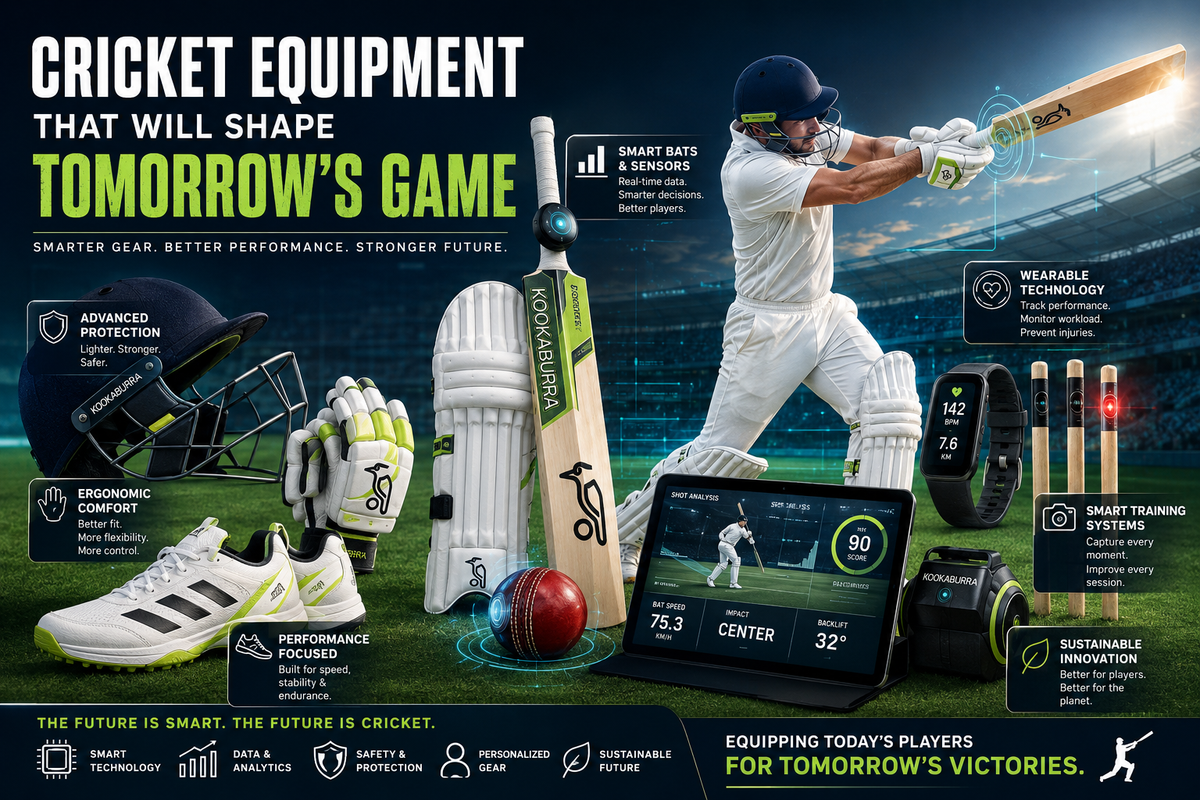
Cricket Equipment That Will Shape Tomorrow's Game
Cricket has always evolved with its players. From traditional wooden bats and leather balls to lightweight protective gear and advanced training technology, equipment has continuously changed to meet the demands of the modern game.
Today, cricket is entering another exciting phase. Smart sensors, advanced materials, data analytics, wearable technology, and performance-focused designs are beginning to influence how players train, compete, and understand their game. The equipment of tomorrow will not simply help players play cricket—it will help them play smarter.
1. Smart Cricket Bats
The cricket bat may become one of the most intelligent pieces of sporting equipment on the field.
Modern bat sensors can already capture information such as bat speed, swing movement, impact characteristics, backlift, and follow-through. The ICC has previously demonstrated bat-sensor technology capable of measuring multiple aspects of a player's swing.
Future smart bats could take this even further by providing players with instant feedback through mobile apps. Instead of simply knowing that a shot went for four, players could understand how they generated the power, where they made contact, and how their swing changed during a training session.
For young cricketers, this could make coaching more precise and measurable.
2. Advanced Protective Equipment
Player safety will remain one of the biggest priorities in cricket equipment design.
Future helmets, batting pads, gloves, chest guards, and thigh protection could combine lighter construction with stronger impact-management materials. Research and innovation are increasingly focused on improving protection without making equipment unnecessarily heavy or restrictive.
The goal is simple: maximum protection with minimum interference.
Imagine batting equipment that feels significantly lighter while intelligently distributing impact across multiple protective layers. That could allow players to move more naturally while maintaining confidence at the crease.
3. Wearable Performance Technology
Cricket is not just about what happens when the ball reaches the bat. Fitness, movement, workload, recovery, and biomechanics all influence performance.
Wearable technology could help players and coaches monitor movement patterns, training intensity, workload, and other performance indicators.
Combined with cricket-specific analytics, this information could help coaches create more personalized training programs rather than relying solely on traditional observation.
4. AI-Powered Cricket Training
Artificial intelligence could become one of the most influential technologies in cricket development.
AI systems can analyze large amounts of performance information and identify patterns that may be difficult for humans to recognize. Cricket innovation initiatives are already exploring AI, machine learning, performance analytics, and injury-prevention applications.
In the future, an AI-powered training system could analyze a player's batting technique and recommend specific adjustments.
For example:
- Bat swing is becoming slower against short-pitched bowling
- Front-foot movement is inconsistent
- Head position changes during certain shots
- Bowling release point varies between deliveries
- Workload has increased significantly during training
Instead of simply saying "practice more," technology could help explain exactly what needs attention.
5. Intelligent Cricket Balls
The cricket ball could also become part of the data ecosystem.
Future training balls may incorporate technologies that help coaches analyze release speed, spin, trajectory, bounce, or movement. While traditional match balls will always remain central to cricket's identity, smart training equipment could give players additional information during practice.
This could be particularly valuable for bowlers looking to understand variations in pace, seam position, or spin.
6. Connected Training Equipment
Training equipment is also becoming more intelligent.
Smart stumps, connected cameras, automated bowling machines, motion sensors, and digital scoring systems can create a more complete picture of a player's performance.
The ICC has already explored technology such as wireless stump cameras designed to bring advanced analysis and review capabilities to grassroots cricket.
For clubs and academies, connected training environments could eventually allow every session to become a measurable learning experience.
7. Personalized Cricket Gear
The future of cricket equipment will likely become more personalized.
Players have different body shapes, techniques, positions, and playing styles. Instead of a one-size-fits-all approach, advanced manufacturing could allow equipment to be customized for individual players.
3D scanning, digital design, and improved manufacturing techniques could make personalized bats, protective equipment, shoes, and grips increasingly accessible.
A young fast bowler may need completely different equipment characteristics from a wicketkeeper or an aggressive top-order batter.
Tomorrow's equipment will increasingly reflect those differences.
8. Lightweight Materials
Weight is one of the biggest factors in cricket equipment.
Players want protection and durability without feeling restricted. This is driving interest in advanced composites, engineered foams, lightweight fibers, and other high-performance materials.
The future could bring cricket gear that offers greater protection while reducing unnecessary weight.
For bats, this could mean improved weight distribution. For pads and gloves, it could mean more mobility. For helmets, it could mean improved protection without sacrificing comfort.
9. Immersive Training and Virtual Reality
Technology may also change how players practice situations that are difficult to recreate on a traditional cricket field.
Virtual and augmented reality can simulate match environments, bowling styles, pressure situations, and different field placements.
The ICC has already experimented with immersive cricket experiences, including VR and AR technologies designed to bring fans and players closer to the game.
For developing players, immersive training could eventually provide realistic practice opportunities without requiring a full team or an expensive training facility.
10. Sustainable Cricket Equipment
The future of cricket equipment is not only about technology. Sustainability will become increasingly important.
Manufacturers may explore recycled materials, longer-lasting components, environmentally responsible packaging, and manufacturing processes that reduce waste.
The best equipment of tomorrow will need to perform on the field while also considering its impact off the field.
The Future Will Combine Technology With Tradition
Technology will not replace the fundamentals of cricket.
Players will still need timing, patience, technique, fitness, concentration, and tactical intelligence. A smart bat cannot play a cover drive for you, and advanced protective gear cannot replace good technique.
Instead, future equipment will act as an additional tool.
The biggest opportunity is the combination of traditional cricket knowledge with modern technology. Data can help explain technique. Sensors can provide measurements. AI can identify patterns. Advanced materials can improve comfort and protection.
But the player remains at the center.
What This Means for Cricket in the USA
Cricket is expanding its presence across the United States, creating opportunities for new players, clubs, academies, and communities.
As participation grows, modern equipment can help make training more accessible and professional. Technology can give developing players access to insights that were once mainly available to elite athletes.
That could be particularly important for young American cricketers who are building their skills and looking for new ways to compete at higher levels.
Final Thoughts
The cricket equipment of tomorrow will be lighter, smarter, safer, more personalized, and increasingly connected.
Smart bats may measure every movement. Wearables may monitor performance. AI may help coaches identify opportunities for improvement. Advanced materials may redefine protection. Virtual technology may transform training.
Yet the heart of cricket will remain unchanged.
The future of cricket equipment is not about replacing the player. It is about giving the player better tools to reach their potential.