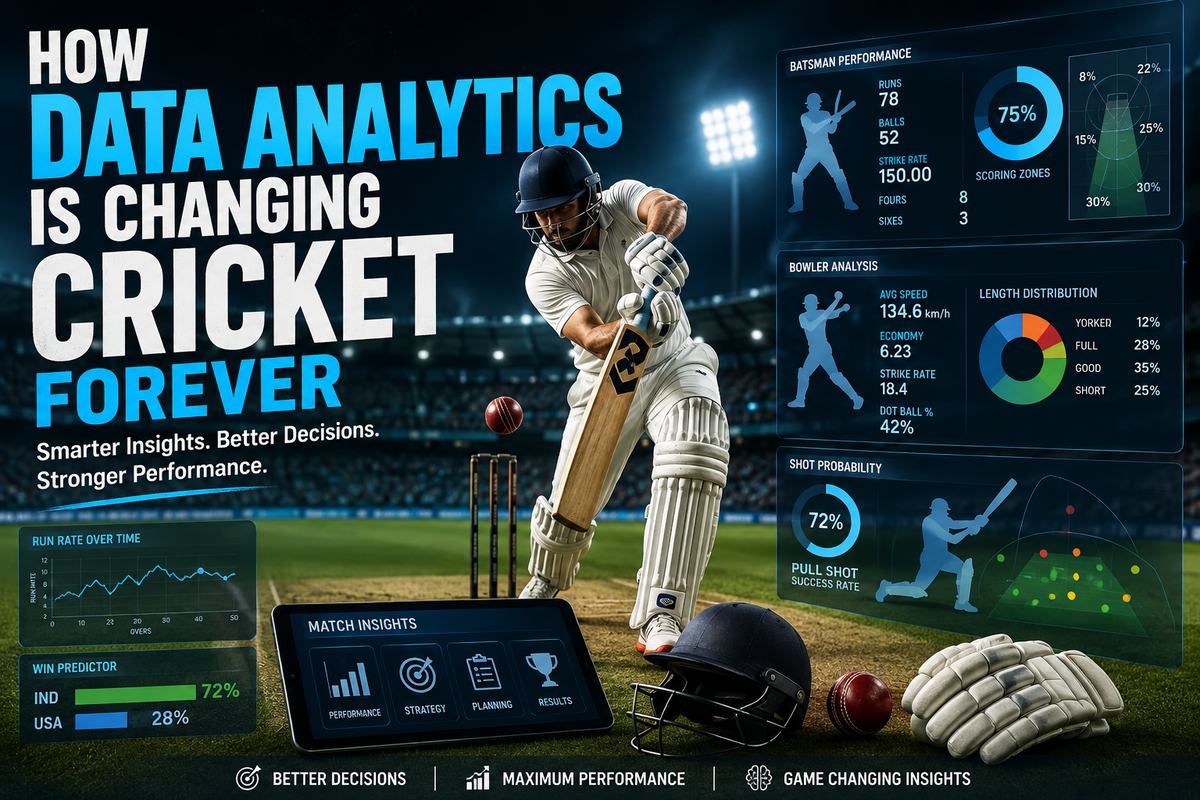
How Data Analytics Is Changing Cricket Forever
Cricket has always been a game of skill, instinct, and experience. But in the modern era, another force is transforming how players prepare, teams strategize, and coaches make decisions: data analytics.
From tracking a batter’s scoring zones to analyzing a bowler’s release point, cricket is increasingly becoming a data-driven sport. For the growing cricket community in the United States, this evolution is especially exciting because technology is helping players and teams develop faster while bringing a more analytical approach to the game.
What Is Data Analytics in Cricket?
Data analytics involves collecting and studying information from matches, training sessions, and player performances. Modern cricket systems can track everything from runs and strike rates to bowling speed, movement, shot selection, fielding efficiency, and player workload.
Instead of relying only on what the eye sees, coaches can use data to understand what is really happening on the field.
For example, a batter may feel comfortable playing shots through the off side, but performance data could reveal that their dismissal rate is significantly higher in that area. That information can then influence training and match strategy.
Smarter Batting Decisions
Data analytics has completely changed how modern batters prepare.
Teams can analyze:
- Scoring patterns
- Strike rates against different bowling types
- Favorite scoring zones
- Dismissal patterns
- Performance against pace and spin
- Powerplay and death-over statistics
- Performance against individual bowlers
This allows batters to prepare specifically for their opponents rather than simply practicing general batting skills.
A player facing a fast bowler, for example, can study how that bowler uses short deliveries, yorkers, slower balls, and movement. The batter can then create a training plan around those situations.
Bowlers Are Using Data Too
Bowling has become equally analytical.
Modern performance systems can help identify the ideal line, length, pace, variations, and release points for individual bowlers.
A fast bowler might discover that deliveries slightly outside off stump produce more false shots than deliveries aimed directly at the stumps. A spinner may learn which angles and lengths create the highest percentage of attacking opportunities.
These insights allow bowlers to replace guesswork with measurable performance information.
Field Placement Is Becoming More Precise
Fielding strategies have also entered the data-driven era.
Teams can examine where a batter scores most frequently and position fielders accordingly. If a batter consistently hits boundaries through a particular region, captains can adjust the field to reduce those opportunities.
At the same time, analytics can identify areas where a batter is less effective, encouraging bowlers to attack those weaknesses.
The result is a more strategic battle between bat and ball.
Technology Is Improving Player Development
Data analytics isn't just useful for professional teams. It can also benefit developing players.
Cricket academies and clubs can use performance data to monitor progress over time. Players can compare their statistics from different training sessions and identify areas that require improvement.
For young cricketers in the USA, this can be particularly valuable as the sport continues to grow. Instead of simply asking, "Am I getting better?", players can look at measurable indicators such as consistency, scoring efficiency, bowling accuracy, and fielding performance.
Injury Prevention and Workload Management
One of the most important applications of analytics is player fitness.
Training and match data can help coaches monitor workload and identify periods when players may be experiencing excessive physical demands.
Tracking factors such as bowling volume, training intensity, recovery, and match schedules can help teams make better decisions about rest and preparation.
Data cannot eliminate injuries, but it can provide coaches with additional information for managing player workloads intelligently.
The Rise of AI in Cricket
Artificial intelligence is taking cricket analytics even further.
AI-powered systems can process enormous amounts of match footage and performance data to identify patterns that may be difficult for humans to notice.
In the future, AI could increasingly help players answer questions such as:
- Which delivery type causes the most problems?
- Where should a batter look to score?
- Which field placement is most effective?
- How does performance change under pressure?
- Which technical adjustments could improve consistency?
The goal isn't to replace coaches or players. Instead, technology can give them better information to support their decisions.
Data Doesn't Replace Instinct
Despite all the technology available today, cricket remains a human game.
Statistics can explain trends, but they cannot completely measure confidence, pressure, creativity, leadership, or instinct.
A captain still has to make decisions in real time. A batter still has to react to a ball traveling at high speed. A bowler still needs confidence to execute a difficult delivery under pressure.
The best teams therefore combine data with experience.
What This Means for Cricket in the USA
Cricket is gaining momentum across the United States, from youth programs and recreational leagues to organized club cricket and professional competitions.
As the sport develops, access to performance technology could help American players accelerate their learning curve.
For aspiring cricketers, understanding statistics and performance data may become just as important as practicing batting, bowling, and fielding.
The next generation of American cricket players may grow up using video analysis, wearable technology, performance dashboards, and AI-assisted coaching as a normal part of their training.
The Future of Cricket Is Data-Driven
Data analytics is changing cricket from the grassroots level to the international stage. It is helping players understand their strengths, identify weaknesses, prepare for opponents, manage workloads, and make smarter decisions.
But the future isn't about choosing between technology and traditional cricket.
It is about combining them.
Skill creates the opportunity. Experience provides the instinct. Data provides the insight.
As cricket continues to expand in the USA, this combination could help create a new generation of smarter, stronger, and more prepared cricketers.