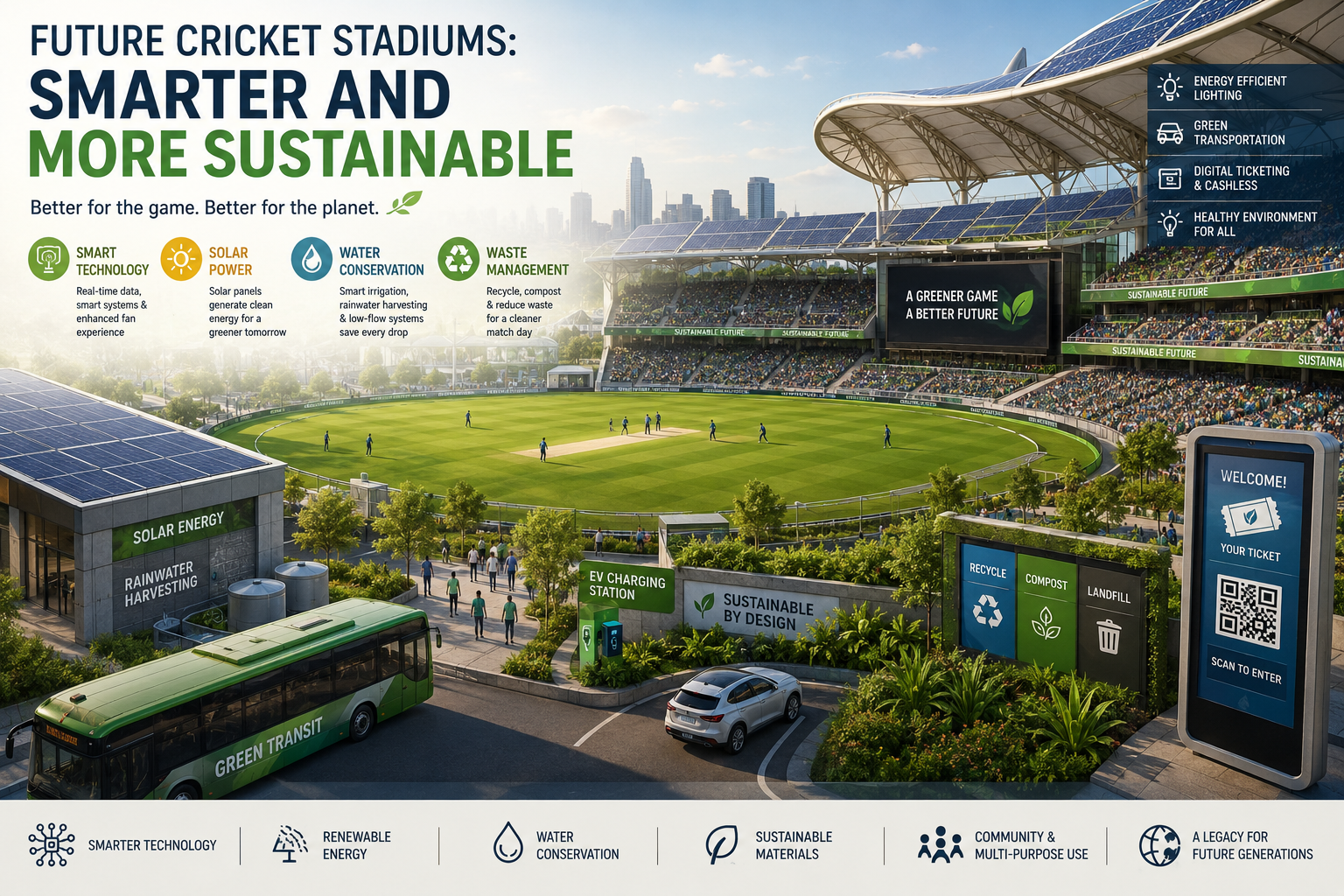
Future Cricket Stadiums: Smarter and More Sustainable
Cricket stadiums have always been more than places to watch a match. They are gathering spaces where technology, entertainment, community, and sport come together. As cricket continues to grow in the United States, the next generation of cricket venues has an opportunity to be designed differently — smarter, more efficient, and more environmentally responsible.
The future cricket stadium will not simply be bigger. It will be better connected, more energy-efficient, water-conscious, and adaptable to changing needs.
Smart Technology Will Transform the Fan Experience
Technology is already changing how fans experience sports, and future cricket stadiums are likely to take this even further.
Smart stadium systems can monitor lighting, temperature, crowd movement, energy consumption, and building operations in real time. Automated systems can adjust lighting and ventilation based on occupancy, helping reduce unnecessary energy use. U.S. sports venues are already using building automation, occupancy sensors, real-time energy dashboards, and advanced controls to improve efficiency.
For cricket fans, this could mean faster digital entry, smart parking, mobile ordering, connected seating, real-time match statistics, and personalized information delivered directly to their phones.
Solar Power Could Become a Major Part of Stadium Design
A cricket stadium has something many buildings lack: enormous roof and parking areas that can accommodate solar technology.
Future venues could use solar panels across stadium roofs, parking canopies, and surrounding facilities. Battery storage could then help store renewable electricity for use during peak periods or evening matches.
Examples from American sports show that this approach is already practical. Petco Park in San Diego has a 336-kilowatt solar array and on-site battery storage, while its electricity supply is sourced through a renewable-energy program.
For future cricket grounds in the U.S., combining solar generation with battery storage could help create more resilient and energy-efficient venues.
Water Conservation Will Be Essential
Water is especially important in cricket because maintaining high-quality playing surfaces requires careful irrigation.
Future stadiums can use smart irrigation sensors, weather data, recycled water, rainwater collection, and low-flow plumbing systems to reduce dependence on potable water.
Some existing sports venues already demonstrate what is possible. Oracle Park uses soil sensors and weather information to optimize field irrigation, while Petco Park uses water meters and low-flow fixtures to monitor and reduce water consumption.
For cricket, these technologies could help grounds teams provide excellent pitches and outfields while using water more responsibly.
Sustainable Construction Will Shape New Venues
Sustainability should begin before the first ball is bowled — during the design and construction process.
Future cricket stadiums can incorporate recycled and locally sourced materials, modular structures, efficient building systems, and designs that make future renovation easier.
The 2024 Nassau County International Cricket Stadium in New York offered an interesting example: grandstands previously used for the Formula 1 Las Vegas Grand Prix were repurposed for the T20 World Cup venue.
This type of adaptable construction demonstrates how temporary or modular infrastructure can reduce unnecessary material use and give sporting venues greater flexibility.
Waste-Free Match Days
A modern stadium must also rethink what happens after the match.
Future cricket venues could feature clearly marked recycling and composting stations, reusable food containers, digital tickets, reduced single-use plastics, and systems that track waste from collection through recovery.
Large cricket tournaments are already experimenting with better waste-management systems. During the 2026 ICC Men's T20 World Cup, the #MaidaanSaaf initiative focused on waste segregation, recycling, composting, and improved match-day waste operations across host stadiums in India.
For American cricket, similar systems could become standard as the sport attracts larger crowds.
Stadiums Designed for More Than Cricket
The stadium of the future should not sit empty between matches.
Multi-purpose design can allow cricket venues to host concerts, community events, youth programs, training camps, conferences, local sports, and other activities throughout the year.
This improves the economic value of the venue while making better use of the resources invested in its construction.
Flexible seating, modular hospitality areas, multipurpose spaces, and adaptable playing surfaces could allow one stadium to serve many different purposes.
Greener Transportation
Transportation can represent a significant part of an event's environmental footprint.
Future cricket stadiums in the United States could be designed around public transportation, walking, cycling, electric vehicles, ride-sharing, and dedicated shuttle services.
The goal would be to make arriving at the stadium easier while reducing the number of individual vehicle trips.
This is already becoming part of sustainable stadium planning. For example, Oracle Park reports that nearly half of its fans arrive by bus, train, ferry, bike, scooter, or on foot.
Cricket Pitches Could Become Smarter Too
The intelligence of a future stadium will extend onto the field.
Grounds teams could increasingly rely on soil sensors, weather forecasting, moisture monitoring, data analytics, and automated irrigation to understand exactly what the pitch and outfield need.
Instead of watering an entire field according to a fixed schedule, smart systems can respond to actual environmental conditions.
This approach could improve pitch consistency while reducing water and energy consumption.
What This Means for Cricket in the USA
Cricket's growth in the United States creates an exciting opportunity.
Rather than simply copying traditional stadium models, American cricket can embrace a new generation of venues built around technology, sustainability, flexibility, and fan experience.
The success of the 2024 T20 World Cup venue in New York showed that major cricket infrastructure can be created in the U.S. with innovative and adaptable approaches.
As Major League Cricket and grassroots cricket continue to develop, future facilities could become important community assets — places where people watch international matches, young players train, families gather, and local communities connect.
The Stadium of Tomorrow
Imagine walking into a cricket stadium where your ticket is completely digital, solar panels help power the venue, sensors automatically manage irrigation, smart lighting responds to activity, waste is sorted for recycling and composting, and stadium systems continuously analyze energy and water use.
That is not science fiction. Sports venues around the world are already implementing pieces of this vision.
The future cricket stadium will be more than a place where matches happen. It will be a smart ecosystem built around people, performance, technology, and the planet.
As cricket establishes a stronger presence in the United States, the opportunity is clear: build stadiums that don't just prepare cricket for the future — build stadiums that help create a better future.