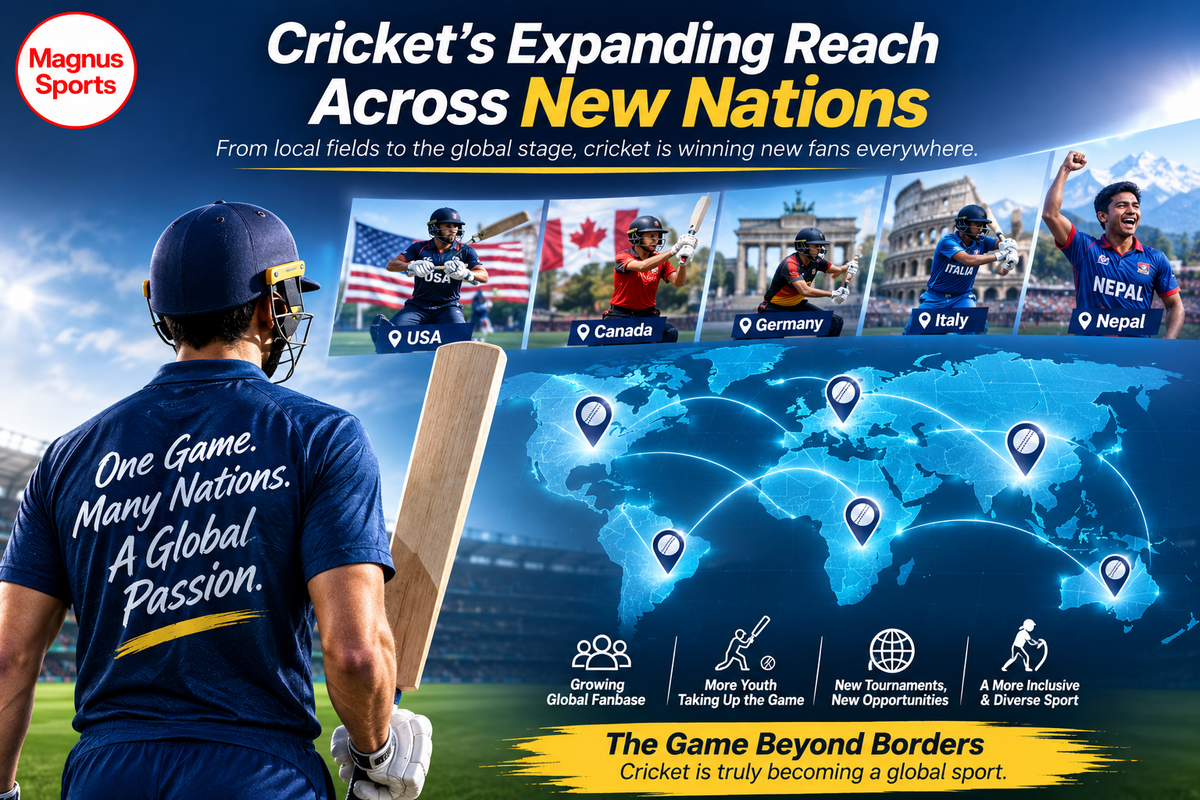
Cricket’s Expanding Reach Across New Nations
Cricket is no longer a sport limited to its traditional strongholds. From the United States and Europe to emerging cricket communities in Asia, Africa, and the Americas, the game is steadily reaching new audiences, inspiring young athletes, and building a truly international sporting culture.
The next chapter of cricket is not simply about producing more elite teams. It is about making the sport easier to discover, play, watch, and enjoy in countries where cricket has historically been a niche sport.
A New Era of Global Cricket
For generations, countries such as India, Australia, England, South Africa, New Zealand, Pakistan, Sri Lanka, and the West Indies have been central to cricket's identity. Today, however, cricket's growth strategy is increasingly focused on expanding into new markets, particularly the USA, Europe, and emerging Asian nations. The ICC has emphasized grassroots participation, digital engagement, and localization as important parts of this expansion.
This evolution is especially important because modern cricket offers multiple formats. T20 cricket, with its shorter matches and fast-paced action, can be easier for new audiences to understand and follow than traditional multi-day cricket.
The United States: Cricket’s Biggest New Opportunity
The United States represents one of the most exciting opportunities for cricket's future.
The 2024 ICC Men's T20 World Cup brought international cricket to American stadiums and introduced the sport to a wider U.S. sports audience. The U.S. team's memorable victory over Pakistan demonstrated that American cricket could create compelling sporting moments on the global stage.
The country's growing cricket infrastructure and professional competitions are also helping provide pathways for players and fans.
The biggest milestone is still ahead: cricket will return to the Olympic Games at Los Angeles 2028. Both the men's and women's competitions will feature T20 cricket, with six teams in each tournament.
For American cricket, the Olympics could be a powerful introduction to millions of sports fans who may be discovering the game for the first time.
Europe Is Building New Cricket Communities
Cricket's European footprint is also expanding beyond England.
Countries such as Italy, the Netherlands, Germany, France, and other European nations are developing clubs, leagues, youth programs, and national teams. Immigration and international communities have played an important role in introducing cricket to new cities, while local players are increasingly discovering the sport through schools and community programs.
The challenge is converting interest into long-term participation.
That means developing accessible facilities, qualified coaches, youth competitions, and affordable equipment. If these foundations continue to grow, European cricket could produce more competitive national teams and a larger fan base.
Emerging Cricket Nations Are Changing the Competitive Landscape
One of the most exciting aspects of cricket's expansion is the emergence of teams capable of challenging established nations.
Nepal, the USA, Namibia, Uganda, Canada, and other developing cricket nations have helped demonstrate that international cricket can thrive outside its traditional centers.
T20 cricket has particularly helped narrow the competitive gap. Shorter formats give developing teams opportunities to compete against experienced sides, while strong performances can generate new interest among local fans.
The result is a more unpredictable and competitive international game.
Women’s Cricket Is Expanding the Sport Even Further
Cricket's global growth cannot be separated from the rise of women's cricket.
Women's competitions are attracting new audiences, increasing participation, and creating opportunities for girls who previously had limited access to organized cricket. The continued expansion of international women's tournaments is helping establish female cricketers as role models for the next generation.
The inclusion of women's T20 cricket at LA28 is another important step. Six women's teams will compete for Olympic medals alongside the men's tournament.
For countries developing cricket programs, investing in girls and women can create an entirely new generation of players and supporters.
Technology Is Helping Cricket Cross Borders
Digital media has dramatically changed how cricket reaches new fans.
A young player in the United States can watch international highlights, follow a professional player on social media, study batting techniques online, or learn about cricket equipment without ever having attended a professional match.
Streaming and social platforms have also made international competitions more accessible. The ICC's global-growth strategy specifically identifies digital platforms and grassroots programs as important tools for building relationships with new audiences.
This means cricket no longer has to depend entirely on traditional television or established cricket markets to grow.
Grassroots Cricket Will Determine the Future
International tournaments can introduce people to cricket, but grassroots programs are what turn curiosity into participation.
Schools, community clubs, youth academies, recreational leagues, and local tournaments are essential to building sustainable cricket cultures.
For the USA in particular, the years leading up to the 2028 Olympics provide an opportunity to introduce cricket to children who may have never held a cricket bat or ball.
The goal should be simple: make cricket accessible.
More fields. More coaching. More youth programs. More local competitions. More opportunities for girls and boys to play.
The Olympics Could Be a Global Turning Point
Cricket's return to the Olympics after a 128-year absence is one of the most significant developments in the sport's modern history. The ICC says the LA28 tournament will use the T20 format, which is designed to be fast-paced and appealing to new audiences.
The impact could extend well beyond Los Angeles.
When people in countries without a deep cricket tradition see their athletes competing for Olympic medals, cricket can become more than an unfamiliar sport. It can become something children want to try and communities want to support.
That is how global sports cultures are built.
What the Future Could Look Like
Cricket's future may feature a much broader competitive map than the game has traditionally known.
New nations could develop professional leagues. More countries could qualify for major tournaments. Women's cricket could reach unprecedented participation levels. Digital platforms could connect players and fans across continents. And Olympic cricket could introduce the sport to millions of new viewers.
The game will still have its traditional powerhouses, but the definition of a cricket nation is changing.
Cricket's next great era may not belong only to the countries that have played it for generations. It could belong to every country willing to pick up a bat, step onto a field, and give the game a chance.
Final Thoughts
Cricket is expanding because the game is adaptable. T20 has made it faster, technology has made it more accessible, and grassroots development is creating opportunities in places where cricket once had little presence.
With the Los Angeles 2028 Olympics approaching and cricket continuing to build momentum in the USA and other emerging markets, the sport has a remarkable opportunity to become more diverse, competitive, and genuinely global.